English News
Improving FDI index paves the way for attracting strategic investments to Hanoi
The 2024 Capital Law stipulates the attraction of strategic investors in Article 42. Clause 1 specifies the list of priority sectors for attracting strategic investors, clearly outlining the areas the Capital city wants to focus on, ensuring resources are used efficiently and strategically. Clause 2 specifies the conditions for strategic investors, outlining concrete criteria regarding financial capacity, technology, experience, and commitments (training, localization, and project implementation according to objectives).
With its strategic location and advantages, along with flexible policies and a continuously improving investment environment, Hanoi has become one of the leading localities in the country in attracting foreign direct investment (FDI), opening up many new development opportunities for the capital in the context of deep integration into the global economy.
According to the Hanoi Department of Finance, in the first 10 months of 2025, Hanoi ranked third nationwide in attracting foreign direct investment (FDI), reaching approximately US$3.9 billion, an increase of about 131% compared to the same period in 2024. This included 350 newly registered projects with a total investment of US$318 million; 123 projects with increased capital totaling US$3,302 million; and 336 instances of capital contributions and share purchases with a value of approximately US$375 million.
The sector attracting the most investment was real estate; followed by manufacturing; trade and commerce; professional and scientific activities; construction; administrative and support activities; finance, banking, and insurance; and other sectors.
Since 1989, Hanoi has attracted approximately US$71.1 billion in FDI. This includes 8,903 newly registered projects with a total investment of US$39.3 billion; 2,427 projects with increased capital totaling US$19.2 billion; and 5,278 instances of capital contributions and share purchases with a value of approximately US$12.6 billion.
Until now, 117 countries and territories have invested in Hanoi. Japan leads with a total investment of over US$15.3 billion across 1,790 newly registered projects; Singapore ranks second with US$14.4 billion across 651 newly registered projects; and South Korea ranks third with US$10.4 billion across 2,989 newly registered projects.
According to the Department of Finance, Hanoi's FDI attraction target is to reach US$25 billion in registered FDI and US$16 billion in implemented FDI by 2030. In addition, the city aims to attract selective, in-depth foreign investment linked to sustainable development goals, prioritizing projects with advanced technology, new technologies, clean and environmentally friendly technologies, and those with spillover effects, connecting global production and supply chains, linked to technology transfer and human resource training.
Investment by countries in Hanoi
It can be seen that Hanoi's FDI partners include many countries and territories with strong economic potential, high technology, and long-term investment strategies in Vietnam. Malaysia is represented by the Gamuda Land project (US$1.12 billion), including Yen So Park and Gamuda Gardens urban area. Singapore invests in real estate, financial services, and high technology. Japan focuses on processing industries, research and development (R&D), and smart cities.
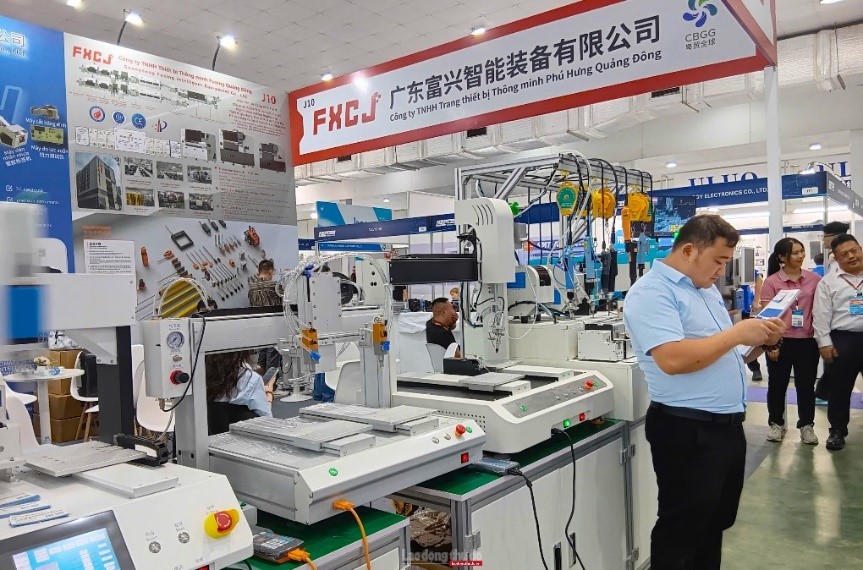
China is investing in commercial and light industrial projects (Illustrative photo)
South Korea invests in electronics component manufacturing, retail, and logistics. China contributes capital to trade and light industry projects. Taiwan (China) invests in manufacturing and digital technology. The diversity of investment partners shows that Hanoi's attractiveness is not limited to traditional partners, but also strongly extends to the Asian regional investment community.
With its existing advantages, along with new mechanisms, policies, and clear development orientations, Hanoi not only maintains its leading position but also aims to attract high-value-added, environmentally friendly FDI that is closely linked with domestic businesses, further affirming its position as one of Vietnam's leading economic and investment centers, steadily progressing on its journey to becoming a smart, green, and modern city of international stature.
At the seminar "Positioning in Participating in the Global Semiconductor Supply Chain: Criteria, Leading Powerhouses, Vietnam's Path, Hanoi's Vision," Mr. Tran Anh Tuan, Director of the Hanoi Department of Science and Technology, emphasized that the city has clearly defined its pioneering role in the development of science and technology, innovation, and national digital transformation. It is ready to experiment with challenging tasks, mastering core technologies such as semiconductors, chips, and artificial intelligence to create sustainable added value, helping the capital city grow and achieve breakthroughs.
According to the city's plan, the Hoa Lac High-Tech Park will be the future "semiconductor capital," aiming to become the "Silicon Valley of Vietnam." Here, Hanoi aims to focus on the APT (assembly, packaging, and testing) field, artificial intelligence research and development (R&D), and high-tech agricultural IoT chip design. By 2030, Hoa Lac is expected to attract approximately US$10 billion in investment, with 30% coming from FDI enterprises in the semiconductor industry.
Simultaneously, Hanoi is leading the country in training high-tech human resources. With major universities such as Vietnam National University, Hanoi University of Science and Technology, and FPT University, the capital city supplies approximately 5,000 STEM graduates to the workforce each year. In particular, the National Semiconductor Training Center under the Vietnam National University, Hanoi, aims to train 10,000 engineers by 2030, focusing on the design and manufacturing of integrated circuits – the foundation for building a sustainable semiconductor value chain.
Source: https://laodongthudo.vn/nang-cao-chi-so-dau-tu-fdi-mo-duong-cho-thu-hut-dau-tu-chien-luoc-vao-ha-noi-201629.html
Tin tức liên quan